● Featured Guides
Explore 21 CNC learning topicsLearn condition monitoring from real dataUse the free CNC calculators

Free CNC Calculators

Spec the machine, then sanity-check the economics. Feed rate & RPM, machining cost per part, machine ROI, and cost-per-part (machine + labor split) — all in one place. 100% free, no signup.
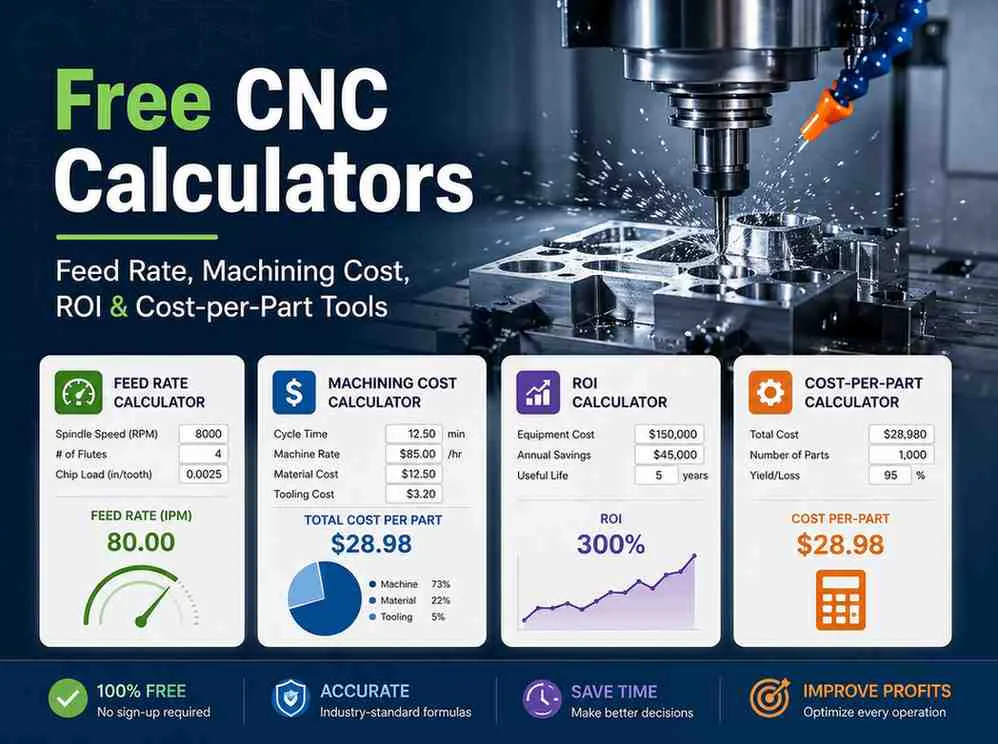
4 Free Tools Metric & Imperial Mills, Routers & Lathes No Signup Required
CNC machining — milling, routing, and precision machining operations in a job shop
Spec It. Cost It. Buy It Right.

Every Number
Your CNC Job Needs

From chip load to cost-per-part to payback period — calculated from your actual machine, material, and labor numbers. Not industry averages.

Browse All Tools
TWC Industrial CNC Calculators
4
Free Calculators
IPM
Imperial + mm·min Metric
50+
Materials in Feed Rate Tool
0
Signup Required
⚙ Core CNC Formulas — Used in These Calculators
Spindle Speed (RPM)
RPM = (SFM × 3.82) ÷ Tool Diameter
or: RPM = (SMM × 318.3) ÷ Tool Diameter
Feed Rate
IPM = RPM × Flutes × Chip Load
mm/min = RPM × Flutes × Chip Load (mm)
Cost per Part
Cost = (Machine Rate × Cycle Time)
+ (Labor Rate × Cycle Time) + Setup + Tooling
Payback Period
Payback = Machine Cost
÷ (Monthly Revenue Gain − Monthly Costs)
🔍 Quick-Win Keywords — CNC Hub

These CNC-specific queries have KD 5–20 with strong commercial intent from machinists and job shop owners. The top-ranking pages are mostly tooling brand calculators (Kennametal, Sandvik) and dedicated machining sites — none match TWC's free, unbranded, metric + imperial format. "People Also Ask" boxes for these queries are largely unanswered by free tools.

CNC feed rate calculator free online chip load calculator CNC milling CNC machining cost calculator per part CNC machine ROI calculator free CNC router feeds and speeds calculator cost per part CNC calculator machine labor RPM calculator CNC milling free how to calculate CNC machining cost per hour

Fast rank (KD 0–10)   Good (KD 11–20)   Medium (KD 21–30)

Editor's Pick
⚙ Most Used · Metric & Imperial · 50+ Materials · Mills, Lathes & Routers
CNC Feed Rate & RPM Calculator

The foundation of every CNC job. Enter tool diameter, flute count, material, and chip load — get optimal RPM and feed rate in IPM or mm·min instantly. Covers carbide and HSS end mills, drills, routers, and turning inserts across 50+ materials from aluminum 6061 to 316 stainless to titanium Ti-6Al-4V. Includes chip load recommendations by material and tool type, plus a troubleshooting guide for dust, chatter, and burning.

Open Tool
All CNC Calculators
Fast Rank ★
CNC Feed Rate Calculator
RPM, chip load, feed rate IPM/mm·min for CNC milling, turning, and routing. Enter tool diameter, flute count, SFM/SMM, and chip load — get production-ready parameters. Metric and imperial. Includes material chip load database and troubleshooting guide (chatter, dust, burning).
RPM Feed Rate IPM mm/min Chip Load SFM / SMM
Fast Rank
CNC Machining Cost Calculator
Estimate total per-part machining cost — material, direct labor, machine overhead rate, setup time amortized over batch, tooling wear, and scrap allowance. Build a quote-ready cost breakdown before you talk to the customer. Outputs cost-per-part and recommended sell price at your target margin.
Cost / Part Material Cost Labor Cost Machine OH Quote Price
Good Rank
CNC Machine ROI Calculator
Calculate payback period, monthly utilization breakeven, and 5-year total cost-of-ownership for a new CNC machine purchase. Factor in labor savings, throughput gains, maintenance, and financing cost. Outputs the business case your bank or ownership group will ask for — before you write the check.
Payback Period 5-Yr ROI Monthly Breakeven TCO
Good Rank
Cost per Part (Machine + Labor)
Split machine time vs. operator labor for accurate per-part cost and pricing. Enter cycle time, machine hourly rate, operator burdened rate, and machine-to-operator ratio — get a clearly split cost-per-part that prevents the most common quoting error in job shops: charging machine time at labor rate.
Machine Cost/Part Labor Cost/Part Total Cost/Part Price at Margin

How to Use These CNC Calculators

Every CNC job has two distinct phases: technical setup (feeds, speeds, chip load) and business economics (cost per part, margin, machine ROI). Most machinists are good at one and weak at the other. These four tools cover both — in the exact sequence you need them.

1 Dial In Feeds & Speeds

Start with the Feed Rate Calculator before touching the machine. Enter your material, tool diameter, flute count, and target chip load — get starting RPM and IPM. Always run a test pass and adjust one variable at a time: if you see dust, raise feed or lower RPM; chatter means reduce depth or adjust RPM; burning means check chip evacuation first.

2 Measure Actual Cycle Time

Run your test part and measure the actual cycle time with a stopwatch — not the CAM estimate. CAM programs consistently underestimate cycle time by 15–30% on complex parts. The actual measured cycle time is the only accurate input for cost calculations. Use it in Step 3.

3 Calculate Cost per Part

Run the Cost per Part Calculator with measured cycle time, your machine rate, and burdened operator rate. This gives you the direct cost floor — the minimum you can charge and break even on direct costs alone, before overhead and profit.

4 Build the Full Quote

Take the cost-per-part from Step 3 into the CNC Machining Cost Calculator to add setup amortization, material cost, tooling, and your overhead percentage. Output a complete cost breakdown and a quote price at your target gross margin. Never quote from memory.

Quick SFM Reference — Common CNC Materials

Starting surface feet per minute (SFM) values for carbide end mills with flood coolant. Increase 10–20% for coated tooling. Decrease 30% for HSS. Use the Feed Rate Calculator to convert SFM → RPM for your tool diameter.

MaterialSFM (carbide)SMM (carbide)Chip Load 1/4" 4-flNotes
Aluminum 6061-T6800–1,000244–3050.003–0.005"Most common, cuts fast
Aluminum 7075-T6700–900213–2740.003–0.004"Harder, slightly lower SFM
Mild Steel 1018300–50091–1520.001–0.002"Use flood coolant
Tool Steel (D2, H13)150–25046–760.0008–0.0015"Low SFM, high rigidity needed
304 Stainless Steel100–20030–610.001–0.002"Work hardens — keep chip load up
Titanium Ti-6Al-4V100–15030–460.001–0.0015"High pressure coolant essential
Brass C360500–700152–2130.002–0.004"Free-machining, sharp tools
Delrin / Acetal600–900183–2740.003–0.006"Air blast, no coolant needed
MDF / Plywood (router)400–600122–1830.006–0.010"Large chip load to clear dust
💡 The #1 CNC Quoting Mistake — Charging Machine Time at Labor Rate

A $28/hr machinist running a $120/hr VMC is NOT a $28/hr operation. The machine rate should be charged separately from the operator labor rate — and when one operator runs two machines simultaneously, the labor cost per machine drops to $14/hr while the machine rate stays at $120/hr each. The Cost per Part Calculator handles this split automatically. Shops that don't separate these costs consistently underprice their machining and wonder why they can't profit despite being "busy."

Using calculator results responsibly

Turn the result into a verified shop decision

1. Check the inputs

Use measured dimensions, current labor and machine rates, and the correct material or process assumptions.

2. Compare with machine limits

Confirm the result against the machine manual, tooling data, applicable code requirements and available capacity.

3. Validate before production

Run a controlled test, record the actual outcome and revise the planning value when shop evidence differs.

Frequently Asked Questions

Two formulas: RPM = (SFM × 3.82) ÷ Tool Diameter (imperial) or RPM = (SMM × 318.3) ÷ Tool Diameter (metric). Then Feed Rate (IPM) = RPM × Number of Flutes × Chip Load per Tooth. Example: 1/2" 4-flute carbide end mill in aluminum 6061 at 900 SFM: RPM = (900 × 3.82) ÷ 0.5 = 6,876 RPM. At 0.004" chip load: IPM = 6,876 × 4 × 0.004 = 110 IPM. These are starting values — always run a test pass and verify with chip color and sound before locking in for production. Use the CNC Feed Rate Calculator to handle the math for any material and tool combination.
CNC machining cost per part = Direct material + (Machine rate × Cycle time) + (Operator burdened rate × Cycle time ÷ machines per operator) + (Setup time × Labor rate ÷ Batch size) + Tooling cost per part. For a 5-minute cycle on a $95/hr VMC with a $38/hr burdened operator running 1 machine, 30-min setup on 20 parts, $3 tooling: ($95 × 5/60) + ($38 × 5/60) + ($38 × 0.5 ÷ 20) + $3 = $7.92 + $3.17 + $0.95 + $3.00 = $15.04 direct cost per part (before material and overhead). Use the CNC Machining Cost Calculator to build this breakdown for your actual numbers.
For carbide end mills in aluminum 6061-T6: 0.002–0.004" per tooth for 1/4" tools, 0.003–0.005" for 3/8", and 0.004–0.006" for 1/2". These are conservative starting values — high-performance coated tools can run 0.006–0.008" chip load in aluminum with adequate chip evacuation. The key diagnostic: if you're making fine powder/dust instead of actual chips, your chip load is too low — raise feed rate or lower RPM. Built-up edge (BUE) on the flutes means your SFM is too low — increase spindle speed. The Feed Rate Calculator includes material-specific chip load recommendations and a troubleshooting guide.
Simple payback = Machine cost ÷ Monthly net benefit. Monthly net benefit = (Additional revenue the machine enables) − (Machine payment + operating costs). For a $120,000 VMC at $2,800/month financed, generating $8,500/month in new machining revenue at 60% gross margin: monthly gross profit = $5,100, less machine payment $2,800 = $2,300/month net. Payback on down payment ($24,000) = $24,000 ÷ $2,300 = 10.4 months. The CNC Machine ROI Calculator also factors in utilization rate, labor savings, and maintenance to produce a 5-year cost-of-ownership comparison for the business case.
Machine rate = the cost to run the machine for one hour: depreciation + maintenance + tooling amortization + electricity + floor space allocation. A typical VMC runs $80–$150/hr machine rate. Operator labor rate = the burdened cost of the person running the machine: base wage + payroll taxes + benefits + workers' comp. When one operator runs two machines simultaneously, the labor cost per machine is halved ($19/hr burdened on 2 machines = $9.50/machine) while the machine rate stays constant at $120/hr each. Confusing these two — or charging everything at a single blended rate — is the most common quoting error in job shops. The Cost per Part Calculator keeps them separate so your quotes stay accurate.
Yes. The CNC Feed Rate Calculator covers CNC routers for wood, MDF, plywood, acrylic, HDPE, and other sheet goods, not just metal-cutting mills. Key differences for routers: chip load is typically larger (0.006–0.012" in wood to clear dust), and the feed rate is often clamped by the machine's maximum axis speed rather than spindle power. For most hobbyist-to-commercial routers (ShopBot, Avid, Laguna), maximum feed rates of 150–300 IPM are the practical limit regardless of what the chip load formula calculates. The tool also includes MDF and plywood in the material library with appropriate SFM ranges for spiral upcut and compression bits.
More Tool Categories

All calculators provide starting-point values only. Always validate feeds, speeds, and costs against your specific machine, tooling, and material before production use. © TWC Industrial · editorial standards · Privacy Policy

TWC Industrial CNC Calculators · Free to Use

Top Picks for CNC Router Tooling

Professional-grade carbide tools ready to ship. Click any product to view details and pricing.
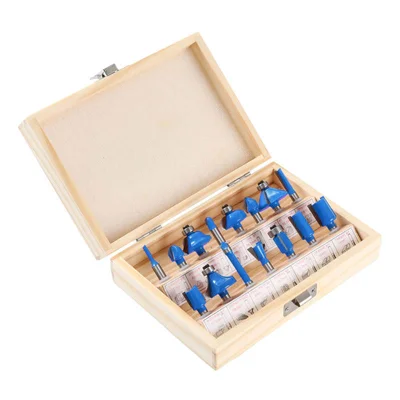
15-Piece Router Bit Set

15-Piece Router Bit Set

Multi-size starter kit with carrying case

View on Alibaba →
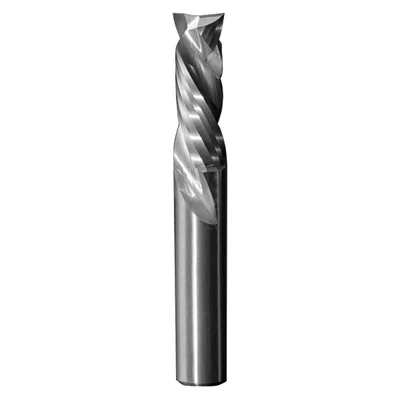
Compression Spiral Router Bits

Compression Spiral Bits

Clean edges on plywood & MDF

View on Alibaba →
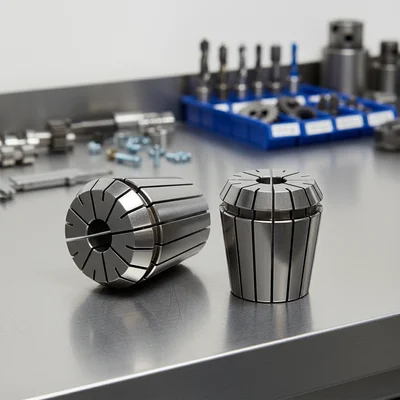
ER Collet Set

ER Collet Set

Precision holding, zero runout

View on Alibaba →

As an Alibaba affiliate partner, we earn from qualifying purchases at no cost to you.